
Hosted By


About the Event
Changemakers! Fire up your relational imagination!
Amid dissonance and division, gather as improvisers of possibility, ensemble players in care, and weavers of bridges toward a more generous world—an ecology of connection where human and more-than-human lives entwine in fragile, co-creative rhythms, reminding us that we belong to a living, breathing assemblage greater than ourselves.
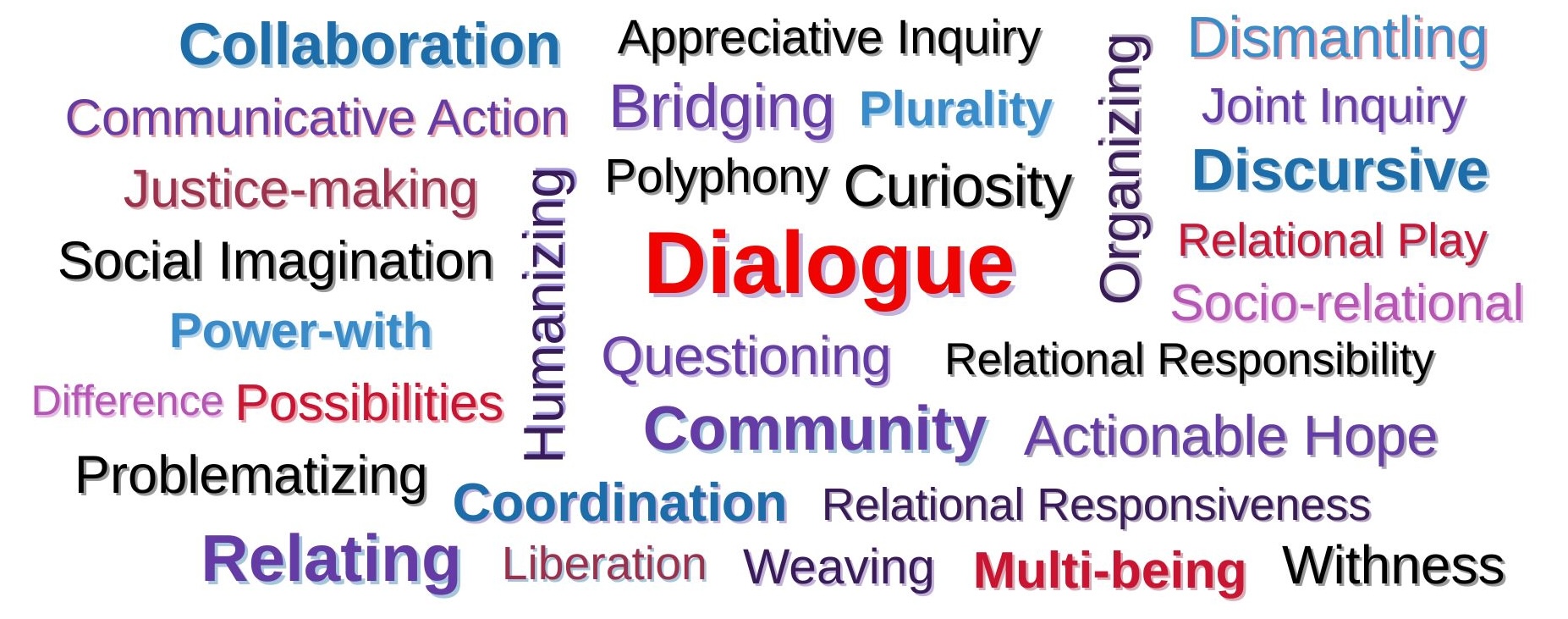
Join us for a vibrant gathering across disciplines to deepen our connections and spark meaningful collaboration–re-imagining our personal, public, and political lives.
Who's the Symposium For
We are intentionally stepping beyond the conventional naming of “who should attend” this symposium. To reimagine our lives requires generative, humanizing conversations, playing with language games that traverse boundaries—drawing upon the richness of lived experience, transcending the predefined disciplines or occupations. Join us if you are seeking to:
- make social transformation
- engage in the generative power of dialogue
- be in the making of justice
- make change that matters
- step into difficult conversations
- be in a transforming embodied experience
- make sense together
- communicate across differences
- be in relational play
Catalytic Conversations

The Socio-Relational Imperative
Why do social and relational practices matter for a generative life, especially in the midst of divisiveness and dissonance? What do we even mean by the relational imperative? How does a constructionist locate the social, and how do we engage it to make better worlds?
Fri, Feb 27, 2026
4:00 PM to 5:15 PM

Money, Measurement & Governance: A Relational Challenge
A sparkling dialogue reimagining the systems and stories that shape our public lives as relational and responsive. How do we not split the social from the economic? Rather, see the economics as a social project, not just socially organizing? What shifts when we center connection, care, justness, and lived experience in how we organize, who (ac)counts, and what’s governed? How might we challenge taken-for-granted regressive norms to co-create more inclusive and dialogic forms of coordination across institutions, communities, and organizations–all viewed as the public sphere?
Sat, Feb 28, 2026
09:00 AM to 10:30 AM

Hope, Agency & Community: Practices for Togetherness
A generative dialogue exploring how we might respond to disconnection and division locally within our communities and relationships: What practices foster belonging, mutual care, and meaningful change today? How might we embrace the processual messiness of co-creating and uncertainty as we bridge differences and power differentials?
Sat, Feb 28, 2026
01:15 PM to 2:45 PM
Catalytic Panelists
Mario Ismael Espinoza
Licensed Clinical Social Worker
Mario Ismael Espinoza, LCSW (they, them) is a queer nonbinary immigrant from Mexico currently residing in the unceded and ancestral land of the Lenape people, modernly known as New York City. Mario is currently following a healer’s journey as a therapist and curanderx. Their practice is informed by both western psychology theories and Curanderismo, an mesoamerican wisdom passed down orally by elders and teachers of turtle island. Mario is thrilled to be included in a dialogue that investigates togetherness and to bring with them the voices and wisdom of all their teachers, guides, and ancestors.
Ken Gergen
President of The Taos Institute
Ken Gergen is a Senior Research Professor in Psychology at Swarthmore College, and President of the Taos Institute. He is internationally known for his contributions to social constructionist theory, technology and cultural change, and relational theory and practice. His major writings include Realities and Relationships, The Saturated Self, and Relational Being: Beyond Self and Community. His most recent book is Relational Evaluation: Beyond the Tyranny of Tests (with Scherto Gill). Gergen is listed among the 50 most influential living psychologists in the world, and has received numerous awards for his work, including honorary degrees in both the U.S. and Europe.
Chris Hoff
Founder of the California Family Institute
Chris Hoff, PhD, LMFT is a narrative therapist, educator, and founder of the California Family Institute in Orange County, CA. He is host of The Radical Therapist podcast and teaches widely on poststructural, relational, and creative practices in therapy. His current work explores chronotopes and futuring as new resources for navigating liminal spaces and composing lives otherwise. Chris integrates philosophy, futures thinking, and Zen practice into his approach, helping therapists expand their imagination and craft practices that are poetic, political, and relational.
Sheila McNamee
Vice President of The Taos Institute
As co-founder and Vice President of the Taos Institute, and Professor Emerita of Communication at the University of New Hampshire, Sheila’s focus has always been on coordinating diversity and creating the conditions that allow individuals, families, & communities with opposing beliefs and values to engage in generative dialogue. By acknowledging the mutually influential relationship between our daily interactions and larger institutional practices (dominant discourses), the significance of how our daily interactions can transform oppressive institutional practices can be realized. Thus, the creative power of co-creation assists us in forming more humane futures.
Abbie VanMeter
Executive Director of Collaborative Innovations
Abbie VanMeter is the Executive Director of Collaborative Innovations at the CMM Institute for Personal and Social Evolution, where she uses the Coordinated Management of Meaning (CMM) to teach a ‘communication perspective’ that empowers individuals to see themselves as active participants in creating better social worlds through better communication. She facilitates initiatives that cultivate more relational ways of being and hosts the Stories Lived. Stories Told. podcast, with over 25,000 listens worldwide. In each episode, Abbie is joined by a different conversation partner, and together they explore their stories, experiences, and expertise using a communication perspective.
Saliha Bava
Prof. & Program Director, Marriage & Family Therapy, Mercy University
Mercy University’s Marriage and Family Therapy Program—a systemic program grounded in socio-relational approaches to working with families, couples, and individuals—enters a new phase under Saliha Bava’s stewardship. Her leadership vision centers on creating contexts where students don’t just study these transformative ideas but experience and co-create together, sensing firsthand the power that emerges when people gather with intention. It’s about adopting a discursive view of therapeutics by expanding the conversations across disciplines, culture, and differences, cultivating a more expansive processual sensibility of socio-relational practices for our just future-forming world.
Relational Facilitators
Sarah Filman
Founder of Playful Perspectives
Sarah Filman (she/they) is a leadership coach, facilitator, and improviser who uses play as a catalyst for human development. As founder of Playful Perspectives and volunteer with Global Play Brigade, Sarah designs experiences where leaders reconnect with possibility, teams navigate conflict with curiosity, and strangers across continents discover what emerges when they yes-and each other. Drawing on nearly two decades of leadership experience in tech and education (Code.org, Microsoft), Sarah brings strategic thinking and a playful spirit to supporting growth at individual, team, and community levels. Their “Soft Skills for Hard Conversations” workshop series was funded by Boston’s Office of Arts and Culture.
Somer Saleh
Licensed Marriage and Family Therapist
Somer Saleh, LMFT, is a Licensed Marriage and Family Therapist in New York and New Jersey and an adjunct professor at Mercy. Her work centers the healing of individuals, families, and communities navigating culture, faith, migration, and intergenerational trauma, with a particular focus on Muslim communities. She brings extensive experience in nonprofit and community-based leadership, advancing culturally responsive, accessible, and ethically grounded care through education, advocacy, and programming rooted in lived experience and collective care.
Cathy Salit
Founder of Global Play Brigade
Cathy Salit is an executive coach, author, social entrepreneur, jazz singer and actor/improviser. For 23 years, Salit was CEO of the maverick leadership consultancy Performance of a Lifetime. She and her team worked with top brand clients, including Amex, IBM, Nike, PwC, Slack, CARE, Pfizer, U.S. Olympics, and Johns Hopkins Hospital, pioneering a powerful learning methodology of a unique blend of theater, improvisation and social therapeutics. Cathy is the founder of the Global Play Brigade, faculty at the East Side Institute, a Taos Associate, and on the board of The Institute for New Music.
Amos Wolff
Licensed Marriage and Family Therapist
A native New Yorker, Amos grew up in an artistic household in the Hudson Valley, where play was encouraged as a means of expression and exploration. From an early age the theatre was a space for him to channel his energy, hone his talents, and most importantly, feel embraced by a community of likeminded folks. He discovered yoga and meditation as a teenager to help balance the high-intensity training in the performing arts and has consistently returned to these practices throughout his life to maintain equilibrium. An adjunct MFT faculty, Amos lives with his husband, their adoptive children, and dog HattieMae.
About the event
This symposium invites us to reimagine our public and political lives through generative formats: Catalytic Conversations spark shared inquiry; Food for Thought papers seed discussion; Dialogic Reflections deepen themed exploration; and Embodied Self-Organizing Spaces empower participants to convene around emergent questions, cultivating a truly participatory and relational gathering.
Catalytic Conversations Panels
Catalytic Conversations are generative dialogues where thought leaders seed ideas, spark inquiry, and invite collective reflection on vital themes.
Food for Thought Papers
Food for Thought papers are short, provocative submissions that pose questions, share insights, or spark dialogue around key symposium themes.
Dialogic Reflections
Dialogic Reflections are breakout spaces for thematic conversation, inviting collective inquiry around pre-submitted “Food for Thought” provocations.
Embodied Self-Organizing Spaces
Embodied Self-Organizing Spaces are open, flexible sessions where participants initiate and host conversations, activities, or collaborations sparked by emerging themes or shared interests.
Registration
The Symposium is limited to 80 people for an intimate gathering and sharing of ideas. All accepted “Food for Thought” participants need to register to confirm.
We have reached capacity. To be added to the waitlist, please click the button to learn more!
Reimagining our personal, public, and political lives
Join us for a vibrant gathering across disciplines to deepen our connections and spark meaningful collaboration, re-imagining our personal, public, and political lives.
Contact
1-(440)-201-9118
Mercy University,
Manhattan Campus
47 West 34th Street
(Near Herald Square)
New York, NY 10001